
Blood tests on Neo-Mercazole: thyroid checks, blood counts and liver tests
Which blood tests you need on carbimazole or methimazole and when, what TSH, free T4, T3 and TRAb results mean, and when a blood count is urgent.
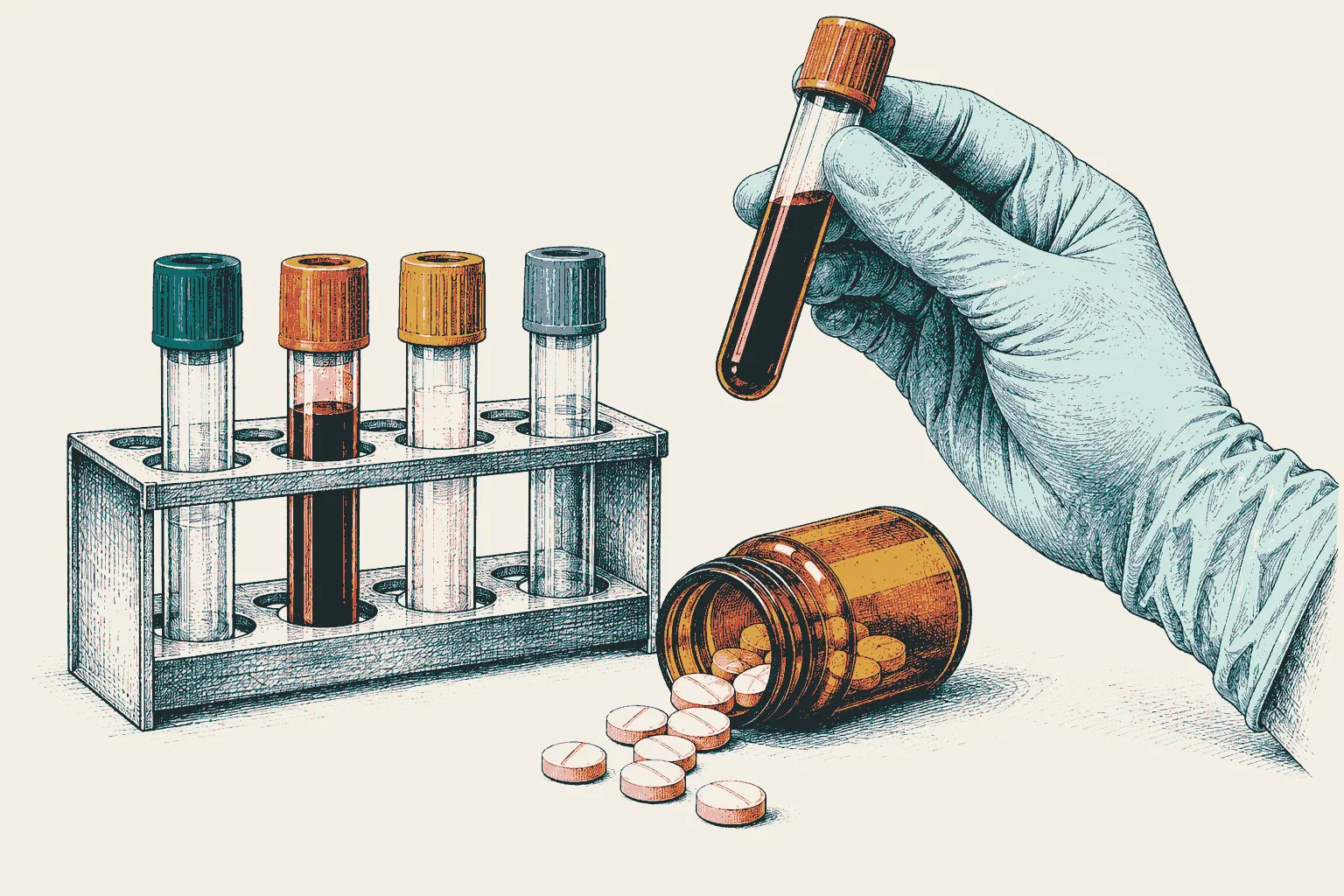
Blood tests run the whole course of treatment with Neo-Mercazole (carbimazole) or methimazole. Thyroid tests decide your dose. Blood counts and liver tests catch the rare serious side effects. And one antibody test helps decide when it is safe to stop. Here is what each one is for and roughly when to expect it.
Key points
- Before starting: thyroid tests to confirm the diagnosis; often a full blood count and liver tests as a baseline.
- While the dose is adjusted: thyroid tests about every six weeks (NHS).
- Once stable: thyroid tests about every three months for as long as you take it.
- Any time you get a sore throat, fever or mouth ulcers: an urgent full blood count, the same day.
- Before stopping: TSH receptor antibodies (TRAb), which predict relapse.
Thyroid function tests
These guide every dose change.
| Test | What it shows on treatment |
|---|---|
| Free T4 | The main hormone level. It falls first and is the best guide early on. |
| Free T3 | The active hormone. Doctors read it alongside T4, because the two do not always fall together. |
| TSH | The pituitary’s signal to the thyroid. It is suppressed when hormone is high and can take a while to recover; a rising TSH once you feel well means the dose is now too high. |
The US methimazole label makes that last point directly: once the overactive thyroid has settled, a rising TSH means a lower maintenance dose is needed. Too much medicine gives the symptoms of an underactive thyroid: tiredness, feeling cold, weight gain, and in some people a growing goitre.
How often
The NHS describes blood tests about every six weeks when you first start, then every three months once your hormone levels are stable, for as long as you take carbimazole, with extra tests in pregnancy or if symptoms suggest the dose is wrong. The Neo-Mercazole product information suggests monthly reviews in the first year and three- to six-monthly reviews after that.
Full blood count: the safety test
Carbimazole and methimazole can rarely wipe out neutrophils, the white cells that fight bacteria (agranulocytosis). It usually comes on suddenly: in a Japanese analysis of 754 cases, 84.5% started within 90 days of starting treatment, often soon after a normal count. That is why the most important “test” is your own symptoms.
Whether to also check counts routinely is debated. The New Zealand Neo-Mercazole data sheet asks for counts before starting and weekly for the first six weeks in higher-risk situations: doses over 40 mg a day, patients over 40, and the first two months of treatment. A Japanese hospital that checks granulocytes at every visit found 16 of its 25 agranulocytosis cases that way, many before any symptoms. The US methimazole label, by contrast, asks for a white cell count when symptoms such as sore throat, fever or rash appear. NICE in the UK recommends a full blood count and liver tests before starting, and then not routinely unless agranulocytosis or liver problems are suspected. Ask your doctor which approach your clinic uses; either way the symptom rule above applies.
Liver tests
Carbimazole and methimazole can cause liver inflammation or cholestatic jaundice. A baseline test is common, and liver tests are repeated straight away if you get upper abdominal pain, loss of appetite, generalised itching, yellow skin or eyes, or dark urine. With propylthiouracil the liver risk is higher; see propylthiouracil.
Clotting test if you take warfarin
Both drugs can affect vitamin K-dependent clotting, and getting the thyroid back to normal changes warfarin’s effect too. The product information advises extra INR or prothrombin time checks, especially before surgery.
TRAb before stopping
TSH receptor antibodies (TRAb, also called TBII) are the cause of Graves’ disease. The European Thyroid Association recommends measuring them for diagnosis, before stopping antithyroid medicine, and in pregnancy. If they are still high after 12 to 18 months, the guideline suggests continuing the medicine and repeating the test a year later, or choosing radioiodine or surgery. In a Swedish trial, high antibodies at the end of tablet treatment predicted relapse.
Other tests sometimes needed
- Creatine kinase if you develop muscle pain (rare myopathy).
- Blood glucose if you have unexplained hypoglycaemia (rare insulin autoimmune syndrome).
- Pregnancy test if there is any chance you are pregnant.
Keeping supply steady
When treatment seems not to be working after three months, the Neo-Mercazole product information names missed tablets as the most common cause. Order repeats in time: carbimazole is listed by PockDose, Yasabai and VGR Australia. See also dosage and side effects.
Sources
Checked 15 October 2026.
- How and when to take carbimazole (blood tests during treatment) — NHS (UK)
- Neo-Mercazole New Zealand data sheet, sections 4.2 and 4.4 — Medsafe (New Zealand)
- Methimazole tablets prescribing information (laboratory tests) — DailyMed, US National Library of Medicine
- 2018 European Thyroid Association guideline for the management of Graves' hyperthyroidism — European Thyroid Journal
- Analysis of 754 cases of antithyroid drug-induced agranulocytosis in Japan (Nakamura et al., 2013) — Journal of Clinical Endocrinology & Metabolism
- Thyroid disease: assessment and management (NG145), recommendations 1.6.21 and 1.7.10 — National Institute for Health and Care Excellence
- Periodic granulocyte count measuring is useful for detecting asymptomatic agranulocytosis (Nakamura et al., 2016) — European Thyroid Journal
- Graves' hyperthyroidism: antithyroid drugs, surgery or radioiodine (Törring et al., 1996) — Journal of Clinical Endocrinology & Metabolism