
Toxic nodular goitre and toxic adenoma: overactive thyroid nodules and their treatment
Overactive ("hot") thyroid nodules, in a toxic multinodular goitre or a single toxic adenoma. How they differ from Graves' disease, why carbimazole controls but rarely cures them, and how radioiodine and surgery are used.
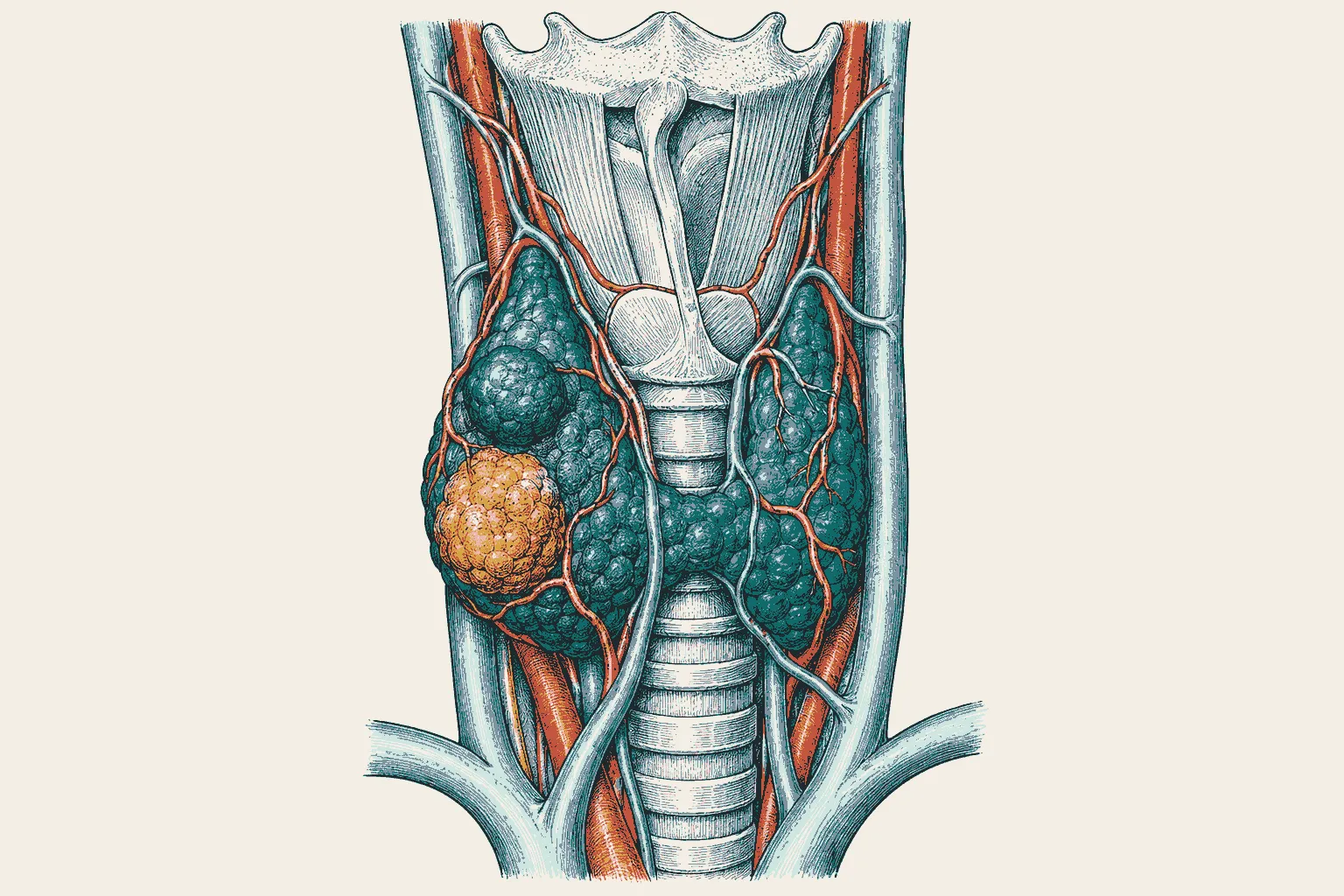
Not every overactive thyroid is Graves’ disease. Sometimes one or more lumps (nodules) in the thyroid start making hormone on their own, ignoring the body’s signals. Several such lumps in an enlarged gland make a toxic multinodular goitre; a single one is a toxic adenoma. Neo-Mercazole (carbimazole) is licensed for this “secondary thyrotoxicosis” too, but it plays a different role than in Graves’ disease.
Key points
- Who gets it: usually people over 60, according to the NHS. The nodules are almost always benign.
- Not autoimmune: TRAb is negative; a thyroid scan shows “hot” nodules.
- Carbimazole controls but does not cure: the nodules keep working when tablets stop.
- Definitive treatment: radioactive iodine first in the UK; surgery, or lifelong tablets, when that does not suit.
How it differs from Graves’ disease
In Graves’ disease an antibody drives the whole gland, and it can switch off after a course of tablets. Toxic nodules are lumps of thyroid tissue that work independently. There is no immune process to settle, so when carbimazole stops, the nodules carry on.
NICE recommends testing TSH receptor antibodies (TRAb) to confirm Graves’ disease and, if the test is negative, considering a technetium scan. On the scan, toxic nodules show up as “hot” areas that take up the tracer while the rest of the gland is quiet.
Large amounts of iodine can also tip a nodular thyroid into overactivity; the NHS mentions iodine-containing medicines such as amiodarone. The Neo-Mercazole product information notes that iodine-induced hyperthyroidism is not an indication for carbimazole, and that a gland loaded with iodine responds to it more slowly.
Carbimazole for toxic nodules
Carbimazole (or methimazole) brings hormone levels down before radioiodine or surgery, or controls them long term when those are not suitable. Expect it to take longer than in Graves’ disease: the product information says nodular goitres can hold large hormone stores, so the response can be delayed for weeks or months, and they “usually take very much longer” to settle.
NICE lists lifelong antithyroid drugs as an option for multiple toxic nodules or a single toxic nodule when radioiodine and surgery are unsuitable. That means indefinite blood tests and the same warning signs as any carbimazole treatment.
Radioactive iodine
NICE recommends radioiodine as the first-line definitive treatment for adults with multiple toxic nodules, and as one of two first options for a single toxic nodule. The British Thyroid Foundation notes it also shrinks the goitre. One difference from Graves’ disease: the British Thyroid Foundation says people treated for a toxic multinodular goitre or a toxic adenoma usually need levothyroxine for less long, whereas after radioiodine for Graves’ disease it is usually lifelong. A small number of people treated with radioiodine for a goitre go on to develop Graves’ disease. See radioactive iodine.
Surgery
NICE offers total thyroidectomy for multiple toxic nodules when radioiodine is unsuitable, and removal of half the thyroid (hemithyroidectomy) for a single toxic nodule. Surgery is also the usual answer when the goitre presses on the windpipe or gullet, grows quickly, or a nodule looks suspicious, the British Thyroid Foundation says. See thyroid surgery.
Which suits whom
| Situation | Usual first choice in the UK (NICE) |
|---|---|
| Several toxic nodules | Radioactive iodine; otherwise total thyroidectomy or lifelong tablets |
| One toxic nodule | Radioactive iodine or hemithyroidectomy; otherwise lifelong tablets |
| Goitre pressing on the neck, or a suspicious nodule | Surgery |
Carbimazole supply
If you are on long-term or pre-treatment carbimazole, it is listed by PockDose, Yasabai and VGR Australia. See also hyperthyroidism.
Sources
Checked 15 October 2026.
- Overactive thyroid (hyperthyroidism), causes — NHS (UK)
- Hyperthyroidism (patient leaflet, updated October 2026) — British Thyroid Foundation
- Thyroid nodules and swellings (patient leaflet) — British Thyroid Foundation
- Treatment of an overactive or enlarged thyroid gland with radioactive iodine (patient leaflet) — British Thyroid Foundation
- Thyroid disease: assessment and management (NG145), recommendations 1.6.1 and 1.6.15 to 1.6.17 — National Institute for Health and Care Excellence
- Neo-Mercazole New Zealand data sheet, sections 4.1 and 4.2 — Medsafe (New Zealand)