
Radioactive iodine for an overactive thyroid: what happens, precautions and stopping carbimazole
Radioactive iodine (I-131) treatment for Graves' disease and toxic nodules, when to stop Neo-Mercazole (carbimazole) before and after, safety precautions, pregnancy timing, eye disease and the long-term underactive thyroid.
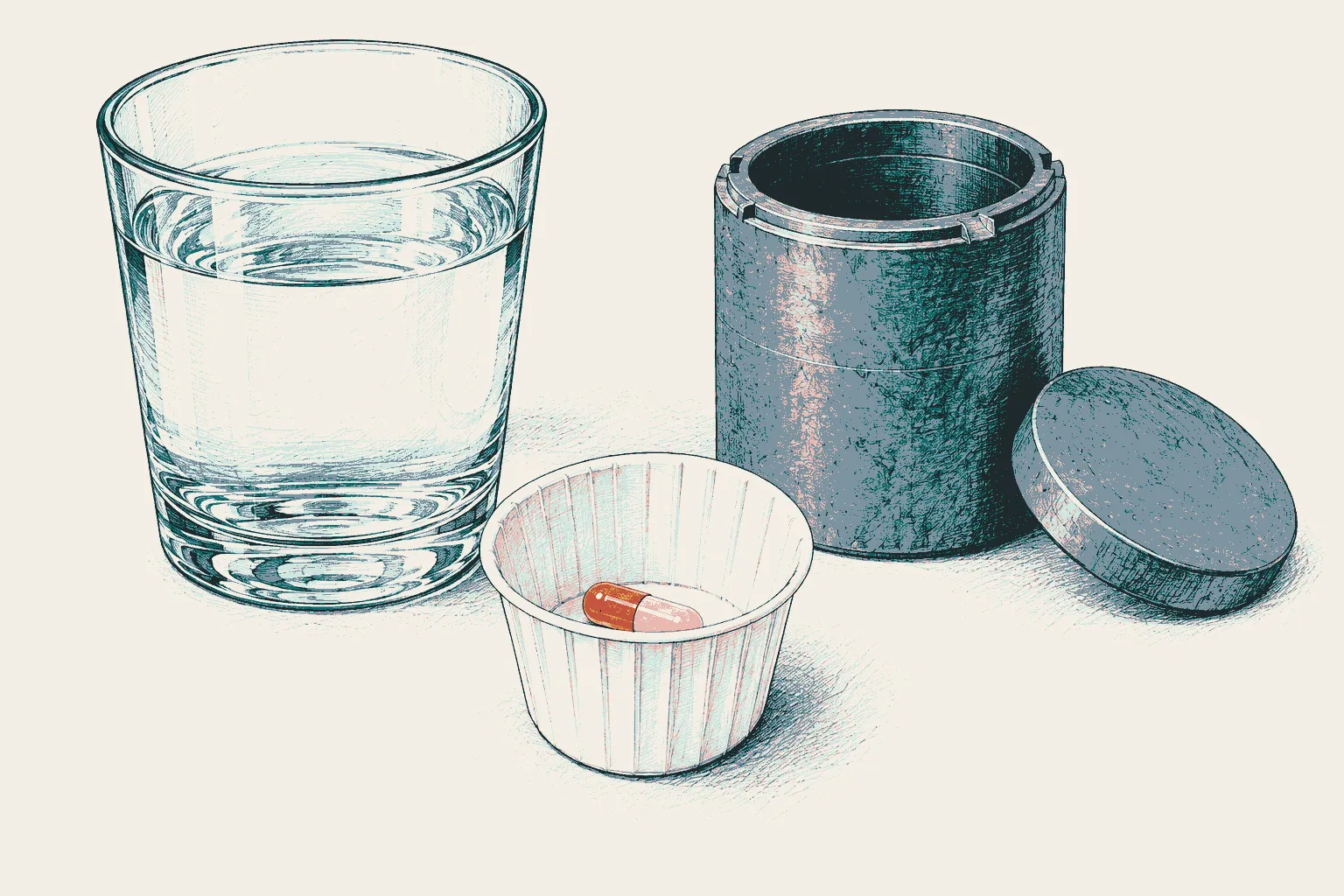
Radioactive iodine (I-131) has been used for overactive thyroids since the early 1940s. The thyroid soaks up iodine, so a capsule or drink of the radioactive form goes almost entirely to the gland and destroys the overactive tissue over the following weeks and months. If you take Neo-Mercazole (carbimazole), you will usually stop it for a while around the treatment.
Key points
- Who it is for: Graves’ disease that relapses or does not settle on tablets, toxic nodules, and in the UK many adults as first-line definitive treatment.
- Carbimazole: usually stopped at least a week before and restarted no sooner than a week after, as your centre directs.
- Precautions: keep your distance from children and pregnant people for about two to three weeks.
- Pregnancy: women should wait at least six months; men should not father a child for at least four months.
- Long term: over two-thirds of people become underactive and need levothyroxine.
When it is used
The British Thyroid Foundation lists toxic nodular hyperthyroidism, Graves’ disease that fails to settle or comes back after tablets, intolerance of antithyroid drugs, and shrinking a goitre. NICE goes further for UK adults: radioiodine is the first-line definitive treatment for most adults with Graves’ disease and for multiple toxic nodules, unless it is unsuitable or a tablet course is likely to achieve remission.
It is not given if you are pregnant or breastfeeding, regularly vomiting or incontinent, or have active thyroid eye disease (unless steroids are given alongside). NICE also lists concerns about compression in the neck, suspected cancer, and plans to conceive or father a child within four to six months.
Carbimazole before and after
A very overactive thyroid can spike higher after radioiodine and, rarely, tip into thyroid storm. So doctors usually bring levels down with carbimazole or methimazole first.
The gland must then be working to take up the iodine. The British Thyroid Foundation says antithyroid tablets are usually stopped at least one week before treatment and not taken for at least one week afterwards; the Neo-Mercazole product information also says to stop it temporarily around the dose. Your centre gives the exact dates, and may suggest a beta blocker to cover symptoms in the gap. Some people restart tablets for a few weeks or months until the iodine has worked.
On the day
Treatment is given in hospital as an outpatient. You swallow a capsule with water, or a drink. There is no single correct dose, and about 10% of people need a second one, according to the British Thyroid Foundation.
Safety precautions afterwards
For a short time you give off some radiation. The British Thyroid Foundation advises keeping at arm’s length from others for two to three weeks, especially babies, children under five and pregnant people; the NHS says about three weeks for children and pregnant women. Your hospital tailors this to your dose and household. Pets are not a concern.
Radiation detectors at airports and ports can pick up the treatment for up to four months, so carry a letter from the hospital if you travel.
Pregnancy: women should avoid conceiving for at least six months and men should avoid fathering a child for at least four months. After that, the British Thyroid Foundation says there is no problem for the baby.
Side effects and risks
- Tender neck for a few days.
- Underactive thyroid: the main long-term effect. Over two-thirds of people develop it, most in the first year. It is treated with levothyroxine tablets.
- Eye disease: radioiodine can trigger or worsen thyroid eye disease, especially in smokers. In an Italian trial, eye disease developed or worsened in 15% of people after radioiodine against 3% on methimazole, and a short course of prednisone prevented it. See thyroid eye disease.
- Cancer: the British Thyroid Foundation describes an extremely small excess risk from studies spanning more than 70 years. The largest, a US and UK cohort of 18,805 treated patients, found a small rise in solid-cancer deaths that increased with dose.
Relapse is uncommon: about 15% in a network meta-analysis, against about half after a course of tablets.
Follow-up
NICE suggests blood tests every six weeks for the first six months, then at 9 and 12 months, then every six months. The British Thyroid Foundation advises tests from four to six weeks after treatment and every one to three months in the first year, then once a year. Do not skip them: an underactive thyroid can be found before symptoms start.
If you still need tablets
If you are told to restart carbimazole while the iodine takes effect, carbimazole is listed by PockDose, Yasabai and VGR Australia. Compare all the options on Neo-Mercazole compared.
Sources
Checked 15 October 2026.
- Treatment of an overactive or enlarged thyroid gland with radioactive iodine (patient leaflet) — British Thyroid Foundation
- Overactive thyroid (hyperthyroidism), treatment — NHS (UK)
- Thyroid disease: assessment and management (NG145), recommendations — National Institute for Health and Care Excellence
- Neo-Mercazole New Zealand data sheet, section 4.4 — Medsafe (New Zealand)
- Relation between therapy for hyperthyroidism and the course of Graves' ophthalmopathy (Bartalena et al., 1998) — New England Journal of Medicine
- Association of radioactive iodine treatment with cancer mortality in patients with hyperthyroidism (Kitahara et al., 2019) — JAMA Internal Medicine
- Comparative effectiveness of therapies for Graves' hyperthyroidism (Sundaresh et al., 2013) — Journal of Clinical Endocrinology & Metabolism